Hiring across borders used to be mostly about cost. Find good talent, sign a contract, wire the money, move on.
That world is gone.
As we move into 2026, global hiring sits in what many call the third wave of outsourcing. Companies are no longer just outsourcing tasks. They’re outsourcing entire capability stacks. Infrastructure, people, platforms, and decision-making tools are all blended together across countries.
This shift creates opportunity, but it also creates risk. Not theoretical risk. Real fines, blocked payrolls, tax exposure, and misclassification audits that can shut down operations fast.
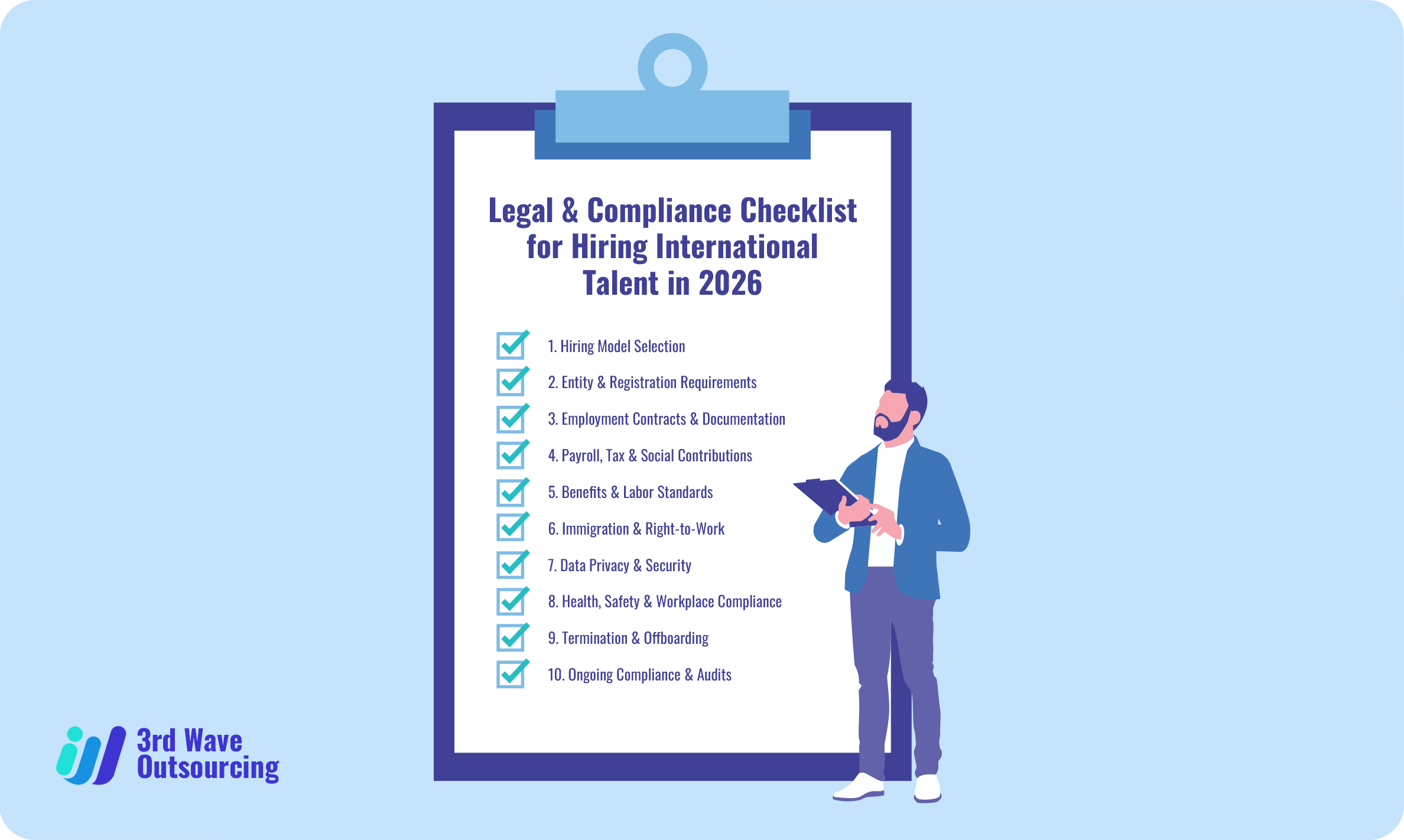
This guide breaks down the legal and compliance realities you need to understand before hiring international talent in 2026, with a clear checklist mindset. No fluff. Just what’s changing and what to do about it.
The Third Wave Outsourcing Reality in 2026
The first wave of outsourcing was tactical IT work. The second wave focused on process efficiency. The third wave, where we are now, is different.
Companies rely on:
- Distributed teams
- Application-driven workflows
- AI-assisted hiring, payroll, and performance systems
- A mix of employees, contractors, and platform workers
Outsourcing is still growing. Most enterprises expect to expand global hiring through 2026. But the complexity has exploded.
Why?
Because governments finally caught up.
Pay transparency laws are everywhere. AI in hiring is regulated. Worker misclassification is under active enforcement. Tax authorities are sharing data. And payroll is becoming real-time, not quarterly.
If you’re still treating compliance as an annual review instead of a daily operating system, you’re already behind.
Pillar 1: AI in Hiring Is Now a Regulated Activity
AI is deeply embedded in hiring and HR. Resume screening, performance scoring, promotion decisions, even termination recommendations.
In 2026, these tools are no longer “just software.” They’re regulated systems.
The EU AI Act Changes Everything
The EU AI Act sets the global standard, and it applies far beyond Europe.
If you:
- Recruit EU candidates
- Employ EU-based workers
- Use HR tools that touch EU teams
You’re covered.
Most HR AI systems are classified as high-risk, including:
- CV ranking tools
- Performance evaluation algorithms
- Promotion and termination decision systems
By August 2026, companies must:
- Perform documented risk and bias assessments
- Maintain audit-ready technical documentation
- Ensure meaningful human oversight
- Notify workers and labor representatives before deployment
Some uses are outright banned, including emotion recognition and social scoring in employment.
Penalties are not symbolic. Fines can reach €35 million or 7% of global revenue.
What Smart Companies Are Doing Now
- Assign a named internal “AI deployer” responsible for oversight
- Audit every hiring and HR tool that uses automation
- Build clear override processes where humans can intervene
- Stop experimenting quietly with AI in HR without legal review
Pillar 2: Pay Transparency Is No Longer Optional
By 2026, salary secrecy is effectively dead.
Europe: Full Transparency by Law
The EU Pay Transparency Directive takes full effect in June 2026. Employers must:
- Share salary ranges before the first interview
- Respond to employee requests for average pay by role and gender
- Publicly report gender pay gaps at certain headcounts
United States: A Patchwork That Acts Like a Standard
States like California, Washington, New Jersey, and Massachusetts now require salary ranges in job postings.
Even if you hire remotely, your job ads can trigger local laws.
The real challenge isn’t writing ranges. It’s discovering that long-term employees are paid less than new hires.
That gap creates legal exposure fast.
Practical Checklist
- Review internal pay bands, not just offers
- Run pay equity audits annually, not reactively
- Align compensation logic across countries
- Use analytics to spot drift early
Pillar 3: India’s Labor Law Reset Is Fully Live
India quietly made one of the biggest labor law changes in decades.
As of late 2025, four national labor codes replaced 29 legacy laws. 2026 is the first real enforcement year.
The 50% Basic Salary Rule
Employers must structure compensation so that basic pay is at least 50% of total wages.
Anything above that threshold gets pulled back into wage calculations.
What this means:
- Higher Provident Fund contributions
- Higher gratuity liabilities
- Higher overall employment cost
Many global firms will see costs rise unless they restructure now.
Fixed-Term Employees Are No Longer “Cheaper”
Fixed-term employees must receive:
- The same wages and benefits as permanent staff
- Gratuity after just one year
- Proper appointment letters
Contract labor is also riskier. If your vendor fails to pay wages, you can be held liable as the principal employer.
Pillar 4: GCC Compliance Is Now Digital and Real-Time
The Gulf region is moving fast.
By January 2026, GCC countries require:
- Digitally registered employment contracts
- Monthly payroll reporting through national systems
- Integrated visa, payroll, and social security records
Systems like Saudi Arabia’s Wage Protection System are not optional.
Missed uploads can freeze work permits.
Nationalization quotas also apply across full-time, part-time, and contract staff. Falling below thresholds impacts licensing and hiring rights.
If you operate in the GCC, manual payroll and offline records are no longer viable.
Pillar 5: The Philippines Has Locked in Social Costs
The Philippines remains a major outsourcing hub, but 2026 brings full implementation of scheduled social contribution increases.
Key points:
- SSS contribution rate is now 15%
- PhilHealth sits at 5%, split evenly
- Pag-IBIG remains mandatory
- 13th-month pay is non-negotiable
Remote workers must receive the same treatment as on-site staff, including holiday pay and service incentive leave.
Leave tracking errors are a common trigger for audits.
Pillar 6: Latin America Is Rewriting the Workweek
Across Latin America, governments are reducing legal working hours while strengthening worker protections.
- Colombia and Chile move toward 42-hour weeks
- Mexico is pushing minimum wages higher and expanding benefits
- Brazil is modernizing tax and telework frameworks
Shorter workweeks increase effective hourly costs and complicate overtime planning.
If you’re scaling in LATAM, workforce planning must account for these shifts upfront.
Pillar 7: Permanent Establishment Risk Is Still Real
Remote work doesn’t automatically create tax exposure, but it can.
OECD guidance now introduces a 50% safe harbor:
- If an employee works less than 50% of their time from a foreign home office, PE risk is lower
- Above 50%, risk depends on commercial intent
If the location exists to serve customers, gain market access, or provide local services, tax authorities may argue you have a taxable presence.
Hybrid models are safer than fully remote single-country hires.
Pillar 8: Worker Misclassification Is Under Active Enforcement
This is where many companies get burned.
Authorities now use data sharing and AI to flag:
- Long-term contractors
- Exclusivity clauses
- Workers embedded in daily operations
The burden of proof is shifting to employers in many regions.
If a contractor looks like an employee, acts like an employee, and depends on one client, they’re probably an employee in the eyes of regulators.
This is why many companies are moving to Employer of Record (EOR) models for international hiring.
Pillar 9: Data, IP, and Security Are HR Issues Now
Distributed teams increase IP leakage risk.
In 2026, compliance means:
- Clear IP assignment clauses
- Role-based system access
- Strong offboarding processes
- MFA and encrypted communications
- Regular access audits
Cybersecurity failures increasingly trigger labor and data protection penalties, not just IT incidents.
Pillar 10: Visibility and Trust Matter for Growth
For global hiring brands, compliance content itself matters.
Search engines now prioritize:
- Real expertise
- Clear authorship
- Practical guidance
Legal and HR content falls under “Your Money or Your Life.” Generic blogs won’t rank or convert.
Complete, experience-based guides perform better than surface-level posts.
Final Takeaways for 2026
Global hiring is easier than ever technically, and riskier than ever legally.
To stay safe:
- Treat compliance as a living system, not a checklist
- Audit AI tools before regulators do
- Formalize remote work and hybrid patterns
- Recalculate costs in India and LATAM early
- Use EORs where local entities don’t make sense
- Invest in payroll systems that report in real time
Companies that get this right won’t just avoid penalties. They’ll move faster, hire with confidence, and scale without surprises.
That’s what the third wave of outsourcing is really about.
Ready to dive deeper into how Third Wave Outsourcing can future proof your business strategy? Download our comprehensive ebook To explore the nuances of finding the best talent, building powerful partnerships, and leveraging this global shift for sustained success. The future of outsourcing is here. Are you prepared to embrace it?