The geographic lottery is dead. For decades, a company’s ambition was handcuffed by commute times. If you couldn’t find a senior developer, a cybersecurity expert, or a specialized data analyst within a 30-mile radius of headquarters, you compromised. You hired second-best or delayed the project entirely.
That rigid dichotomy—where a function was either guarded jealously in-house or hurled over the fence to a disconnected, faceless offshore vendor—has fractured. Organizations trying to navigate the 2026 business landscape with legacy headcount models are getting absolutely outmaneuvered. Their competitors? They’ve embraced a borderless, fluid approach to talent.
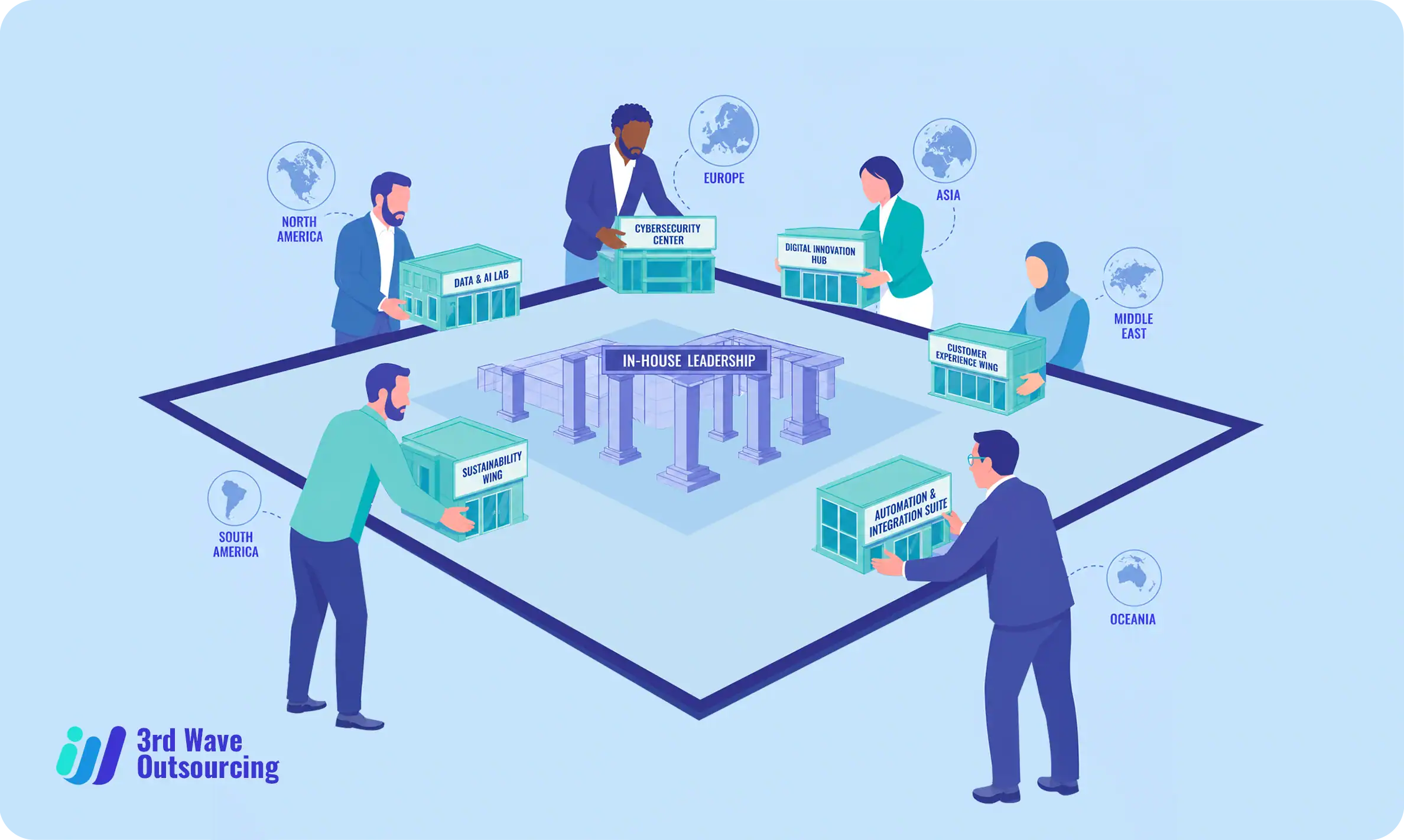
We are officially on the Third Wave of Outsourcing. It’s no longer a desperate mechanism for cost containment. It is the ultimate scaling lever. Today’s most aggressive companies are building a “blended workforce”—a cohesive ecosystem where permanent internal leaders orchestrate highly specialized global talent.
From Labor Arbitrage to Strategic Co-Creation
To understand how we got here, you must look at the historical baggage outsourcing carries.
The first wave (1960s to late 90s) was brutally transactional. The goal was pure labor arbitrage—slashing costs by shipping low-value, repetitive tasks to regions with cheaper wage floors. Vendors were kept on short leashes with restrictive service-level agreements.
The second wave brought process optimization. Mega-BPOs swallowed up entire non-core functions like HR, basic customer service, and payroll. It was more efficient, sure, but it still maintained a massive brick wall between the “core” internal business and the “non-core” external work.
The Third Wave obliterates that wall entirely.
Today, you don’t outsource to save a few pennies per hour; you outsource to buy speed, niche expertise, and immediate access to bleeding-edge tech. We are routinely seeing product development, advanced data analytics, and customer experience design handed over to external partners. Research shows that 81% of executives now outsource parts of their cybersecurity, while an incredible 96% rely on external partners for data modeling.
This forces a massive reality check: What is your actual core competency?
In 2026, your core competency isn’t controlling every process under your own physical roof. It’s your ability to orchestrate world-class experts, regardless of their zip code. Look at the Philippines. Historically known for basic inbound call centers, it has rapidly morphed into a powerhouse for high-value operations. They are now training AI models, executing complex medical coding with U.S.-standard registered nurses, and handling intricate paralegal reviews.
Designing the Ecosystem (Without the RTO Drama)
The blended workforce puts your permanent, in-house hires at the center. They are the architects. They hold the institutional knowledge, shape the long-term vision, and protect the culture.
Surrounding them is a fluid, dynamic layer of contingent talent. This setup acts as workforce insurance against macroeconomic whiplash. Need to deploy a massive cloud security migration? Spin up a pre-vetted external team instantly. Market softening? Scale back the contingent layer without the cultural bloodbath of mass layoffs.
And let’s talk about the physical office. Attempts to drag everyone back through rigid return-to-office (RTO) mandates have backfired spectacularly. Data shows organizations enforcing strict attendance take a 13-14% hit in turnover. The office is no longer a supervision factory—it’s a dedicated venue for deep collaboration and mentoring.
The Global Deployment Playbook
A stack of international resumes isn’t a global hiring strategy. You need a bulletproof legal and financial operating model to avoid tax compliance with nightmares and worker misclassification lawsuits.
Here is how modern human resources leaders structure the deployment:
| Deployment Model | Typical Setup | Core Strategic Advantage |
| Local Entity | 3–6 months | Max control and localized culture for high-headcount regions. |
| Employer of Record (EOR) | 1–2 weeks | Rapid full-time deployment with zero legal entity burden. |
| Contractor of Record (CoR) | Days | Lightning-fast onboarding for short-term, specialized projects. |
| RPO | 1–2 months | Centralized talent acquisition spanning multiple countries. |
Stop treating every global hire as an isolated panic attack. Centralize these channels. Deploy an EOR for that permanent software architect in Eastern Europe and use a CoR for the temporary compliance auditor in Latin America.
Vested Outsourcing: Stop Paying for Inefficiency
The quickest way to kill a blended workforce is through legacy pricing models.
Paying a vendor per hour or per resolved ticket creates a toxic, perverse incentive. Why would an external agency implement AI automation or process improvements if it actively cannibalizes their own billable hours? They won’t.
Enter Vested Outsourcing. This framework torches the transactional vendor agreement and builds an outcome-based partnership. You stop dictating exactly how the work gets done and focus entirely on what the business outcome needs to be.
It relies on margin matching—the internal company and the external partner win and lose together. By utilizing financial incentives for exceeding baseline targets, the service provider is rewarded for generating actual business value. It shifts the entire dynamic from a hostile “What’s In It For Me” (WIIFMe) negotiation to a collaborative “What’s In It For We” (WIIFWe) ecosystem.
The Chaos of Async Execution and AI Orchestration
You can build the perfect strategy in the boardroom, but it will collapse on the ground if you don’t master asynchronous communication.
Trying to force a synchronized 9-to-5 workflow onto a team spread across Manila, Austin, and London is a recipe for burnout and delayed execution. You must adopt an async-first playbook.
- Kill the constant syncs: Routine status updates belong in Jira or Asana. Complex explanations go to Loom videos. Slack is strictly for production-blocking emergencies.
- Protect the overlap: Map your geographic distribution (local time vs. UTC) to find the naturally overlapping hours. Guard these windows ruthlessly. Never waste them on basic reporting; use them exclusively for architectural reviews and solving hard problems.
- Rotate the pain: Don’t permanently burden your offshore specialists with 2 AM calls. Rotate recurring meeting times so the inconvenience is shared equitably.
This orchestration extends directly into how we manage Artificial Intelligence. “Human Readiness” is the new mandate. As AI agents begin resolving 40% to 70% of baseline interaction volume, traditional Workforce Management (WFM) platforms break down entirely.
You aren’t just scheduling humans anymore; you are conducting a hybrid capacity plan. When an AI fails and escalates a task, that residual demand requires a human specialist with entirely different complexity parameters and handle times. Your technology leaders must act as ecosystem orchestrators, ensuring external project specialists and autonomous AI agents plug into your corporate infrastructure without friction.
The Litmus Test: Specialized SEO Execution
Want to see this in action? Look at how modern organizations handle Search Engine Optimization.
You can’t just hire a single internal SEO generalist anymore. The mechanics of search in 2026—dominated by generative AI interfaces and aggressive algorithmic shifts—demand a deeply embedded external team.
An outsourced SEO unit typically brings a strategic lead, technical optimizers, and content architects, integrating directly with your internal product marketers.
They tackle a phased approach:
- Weeks 1-2: Deep technical audits (schema gaps, Core Web Vitals).
- Weeks 3-6: High-impact fixes (canonical errors, page speed).
- Weeks 5-10: Content sprints targeting organic clusters.
Bypassing AI Detection
A critical piece of this execution is generating content that satisfies human readers, ranks on Google, and sneaks past aggressive AI detection engines.
AI writes with low perplexity (highly predictable word choices) and low burstiness (flat, evenly paced sentence structures). To establish real brand authority, blended teams have to heavily humanize the output. They inject deliberate structural entropy—snapping from labyrinthine, multi-clause arguments to blunt, fragmented statements.
More importantly, they use the “interview-yourself” method. Internal subject matter experts record raw, unstructured insights. The specialized external team then uses AI merely to format the narrative, stripping out generic metaphors and replacing them with uncomfortably specific, proprietary data points and contrarian opinions. That is how you build content an LLM can’t hallucinate.
The Future is Orchestration
The blueprint is clear. Building a borderless talent extension is no longer an experimental theory for startups; it is the baseline requirement for survival. By adopting total talent solutions, shifting to Vested Outsourcing, and aggressively protecting asynchronous workflows, you transcend geographic limits.
Stop looking for the perfect candidate in your zip code. Start orchestrating the best minds on the planet.
Ready to dive deeper into how Third Wave Outsourcing can future proof your business strategy? Download our comprehensive ebook To explore the nuances of finding the best talent, building powerful partnerships, and leveraging this global shift for sustained success. The future of outsourcing is here. Are you prepared to embrace it?