Not long ago, hiring globally felt like an experiment. A developer here, a support rep. Useful, but optional. That phase is over.
We’ve entered a new era of hiring where geography no longer defines who gets the job. The companies growing fastest today aren’t asking, “Who can we hire nearby?” They’re asking, “Where is the best person in the world for this role?”
This shift isn’t a trend. It’s a structural change in how work gets done.
From Offices to Outcomes
Remote work didn’t just change where people sit. It changed how companies think about talent.
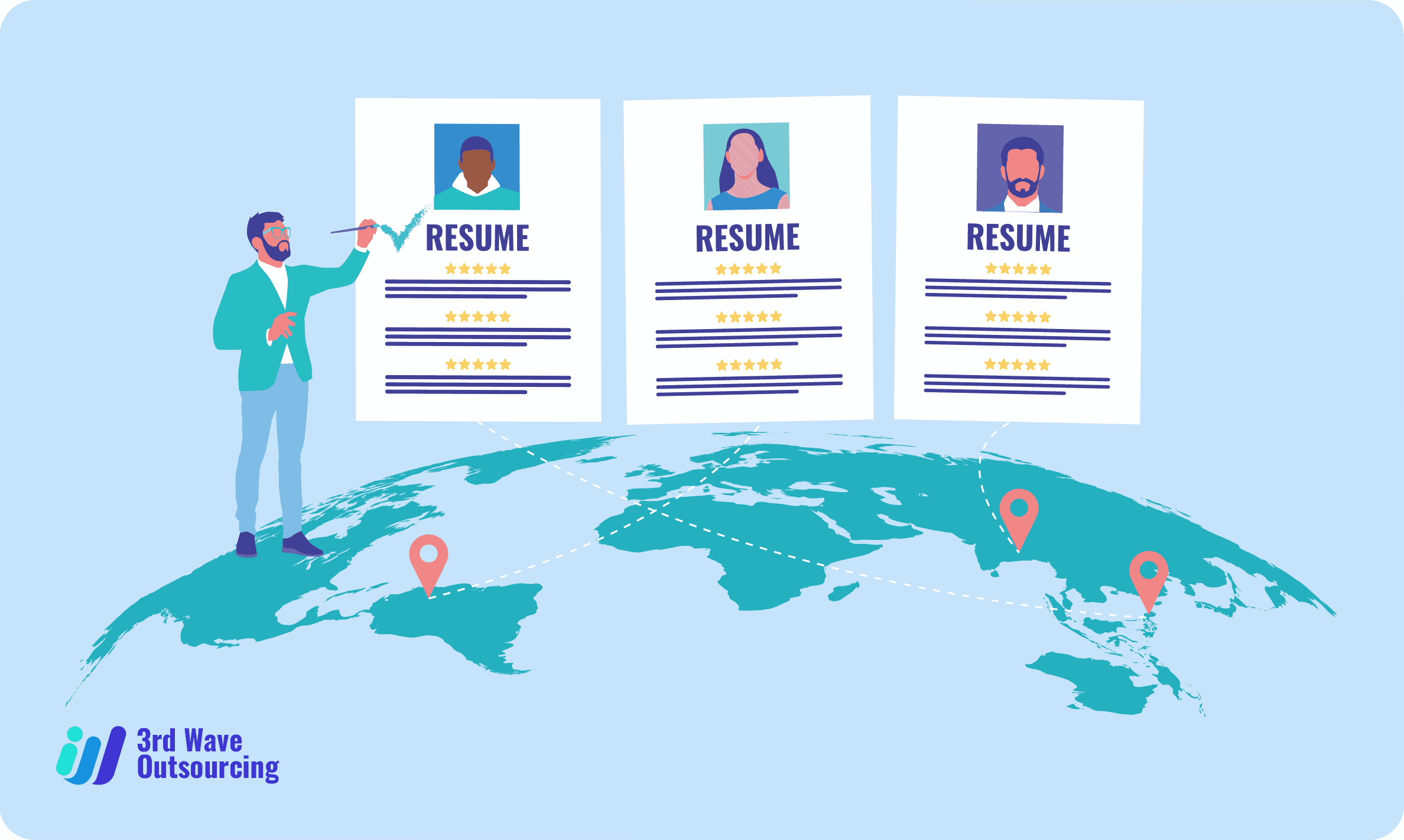
Once teams proved they could operate without sharing a building, a bigger realization followed: the strongest skills rarely sit within commuting distance of one office. The best engineer for your product might live in Bangalore. Your top sales operator might be in Cape Town. Your most reliable finance lead could be in Manila.
That insight has pushed recruitment into what many now call the third wave of outsourcing. Unlike earlier versions, this one isn’t about cheap labor. It’s about capability, speed, and resilience.
How We Got Here: Three Waves of Outsourcing
The first wave began in the 80s and 90s. Companies outsource repetitive, low-value work to cut costs. Manufacturing, call centers, basic admin. Quality and integration were secondary.
The second wave followed in the 2000s. Outsourcing became more strategic. Businesses hired offshore teams for specialized tasks and used time zones to keep work moving around the clock. It was more efficient, but teams were still siloed.
The third wave is different. Today’s companies hire globally not to save money, but to win. Skills come first. Innovation matters more than headcount. Teams are built around outcomes, not locations.
The question is no longer where is it cheapest? Where is the talent that gives us an edge?
Technology Removed the Last Barriers
This shift only works because the infrastructure finally caught up.
Fast internet is no longer limited to major cities. Satellite networks, better fiber, and reliable wireless access mean someone working from a rural area can perform just as well as someone in a downtown office.
Add modern collaboration tools, shared documentation, and AI-assisted workflows, and the old gap between “local” and “remote” disappears. In practice, a well-run distributed team can be more reliable than a centralized one.
AI Changed How Hiring Works
Recruitment itself has been transformed.
Resumes matter less than real proof of skill. Companies now assess candidates based on actual work: code repositories, simulations, portfolios, and problem-solving ability. AI helps sort signal from noise, cutting hiring timelines dramatically.
This doesn’t remove humans from the process. It frees them. Recruiters spend less time scheduling and screening, and more time judging fit, potential, and impact.
The Talent Shortage Is Real
Global hiring isn’t just attractive. It’s necessary.
In many developed economies, the skills companies need simply aren’t available locally. Entry-level white-collar roles are shrinking as automation handles basic tasks. At the same time, demand has exploded for people who can work with AI, secure systems, design complex products, or lead distributed teams.
Meanwhile, skilled trades and hands-on roles are booming. You can automate spreadsheets, but not electrical work or advanced manufacturing. The labor market isn’t collapsing. It’s splitting.
Companies that restrict themselves to local hiring are fishing in an increasingly empty pond.
Why Certain Regions Stand Out
Different regions bring different strengths.
- India remains a global leader in engineering, data, and technical operations. The talent pool is deep, experienced, and increasingly senior.
- The Philippines excels in customer-facing roles, operations, and finance support, with strong communication skills and cultural alignment.
- Latin America offers time-zone overlap with North America and a fast-growing bilingual workforce.
- Poland provides high-end engineering with strong regulatory alignment for European companies.
- South Africa has become a standout for sales, administration, and support roles with native-level English and strong work ethic.
The smartest companies don’t pick one country. They build a portfolio.
The Real Challenges: Compliance and Coordination
Global hiring isn’t plug-and-play.
Worker classification, local labor laws, tax rules, and data privacy all matter. Mistakes can be expensive. That’s why many companies now rely on Employer of Record models or structured global staffing partners. These systems handle compliance so leadership can focus on performance.
The other challenge is communication. Distributed teams don’t succeed by holding more meetings. They succeed by documenting decisions, working asynchronously, and measuring outcomes instead of hours online.
Culture Matters More Than Ever
Hiring globally forces companies to rethink culture.
“Culture fit” often just means “people like us.” That doesn’t scale globally. High-performing teams hire for culture add instead. Different perspectives, different approaches, shared standards.
Clear expectations, good documentation, and fair leadership matter far more than office perks ever did.
Small Companies Finally Have an Advantage
This shift has leveled the playing field.
A 50-person company can now hire the same caliber of talent as a multinational. Modular recruiting, flexible staffing, and AI-powered sourcing mean smaller teams can scale without bloated payrolls or endless HR overhead.
For founders, this reduces growth friction. You don’t need to do everything yourself anymore. You can build real teams earlier, without betting the company on local hiring constraints.
What the Future Demands
The most valuable employees going forward won’t be those with static credentials. They’ll be the ones who learn fast, adapt quickly, and know how to work alongside AI without relying on it blindly.
Judgment, ethics, communication, and decision-making are becoming scarier and more valuable by the year.
Final Thought
Global talent pools aren’t in the future. They’re the present.
Companies that embrace them build faster, stronger, and more resilient organizations. Those that don’t struggle to keep up in a world where skills move faster than borders ever did.
Hiring globally isn’t about cutting costs anymore. It’s about survival, growth, and building teams that can actually compete.
The baseline has changed.
Ready to dive deeper into how Third Wave Outsourcing can future proof your business strategy? Download our comprehensive ebook to explore the nuances of finding the best talent, building powerful partnerships, and leveraging this global shift for sustained success. The future of outsourcing is here. Are you prepared to embrace it?