The global economy is currently going through massive rewiring. If you’ve felt like the old ways of doing business are suddenly out of sync with the world around us, you’re not alone. We’re standing in the middle of what experts call the Third Wave of Outsourcing, and honestly, it’s nothing like the cheap labor hunt of the 90s.
It’s now 2026, and the old cost-cutting playbook is officially obsolete. Today, it’s about talent, innovation, and finding the best people on the planet, regardless of whether they’re sitting in Manila, Warsaw, or right next door.
The Historical Continuum: How We Got Here
To understand where we’re going, we have to look at where we’ve been. Outsourcing isn’t new, but it has morphed into something entirely different over the last sixty years.
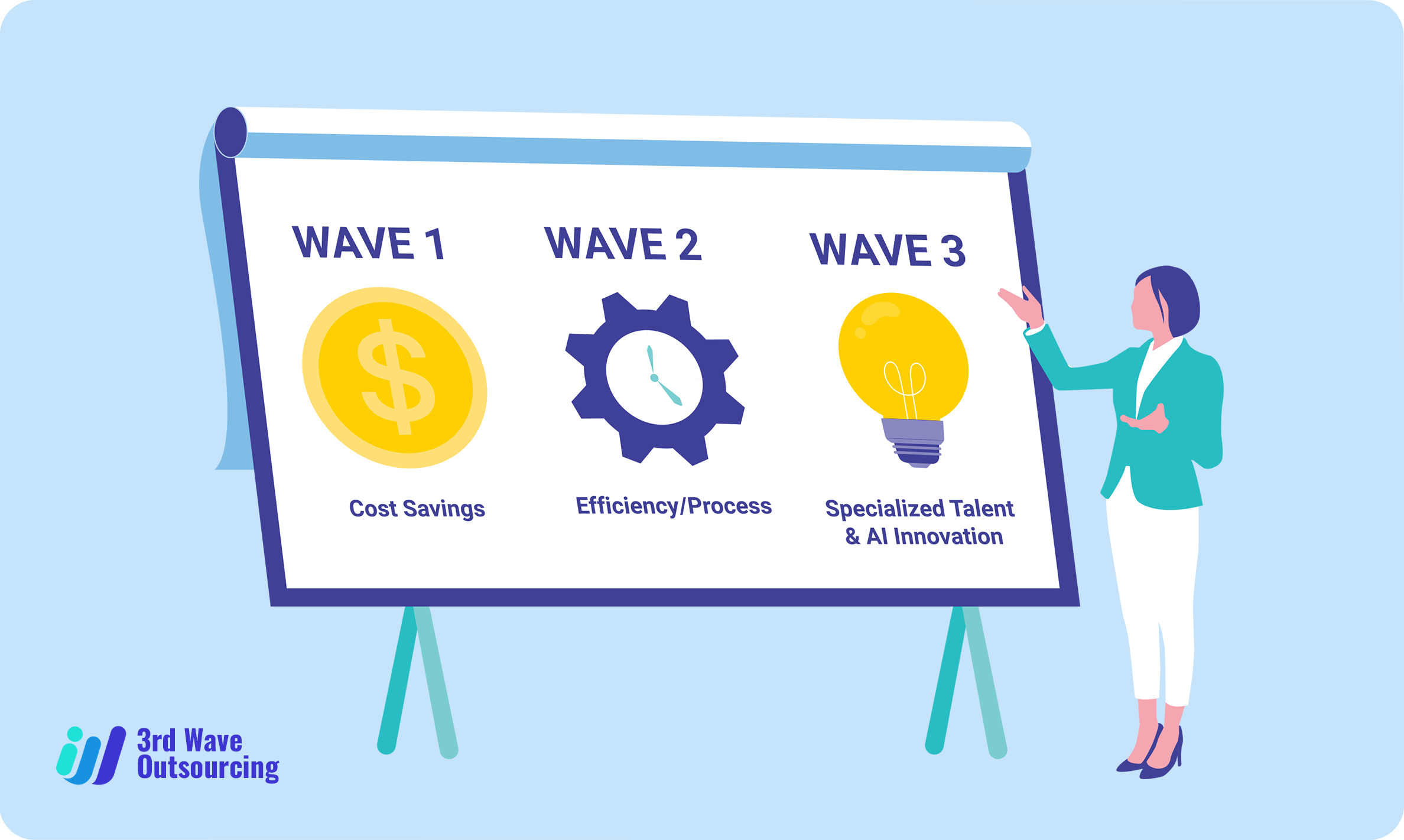
The First Wave: Just Make it Cheap (1960s–1990s)
This was the era of industrial offshoring. Think manufacturing jobs moving to wherever labor was least expensive. It was purely transactional—the goal was to shed non-core functions and save a buck.
The Second Wave: The Rise of the BPO (2000s–2010s)
The internet changed everything. Suddenly, call centers in India and the Philippines could handle customer service in real-time. This gave us the “Follow the Sun” model—24/7 operations that never slept.
The Third Wave: Borderless Talent (2018–Present)
Now, we’re thick of it. The Third Wave isn’t shipping jobs away; it’s about extending your team. Technology has reached a point where the 50-mile radius around your office is irrelevant. We’re looking for technical density and cultural fit, using AI and cloud platforms to make a distributed team feel like they’re in the same room.
Feature | First Wave | Second Wave | Third Wave |
Primary Driver | Cost Arbitrage | Strategic Efficiency | Talent & Innovation |
Type of Work | Manufacturing | Back-office / Service | Skilled Knowledge Work |
Technology | Shipping / Free Trade | Internet / Telephony | Cloud / AI / Platforms |
Relationship | Transactional | Vendor-Vendee | Vested Partnership |
Why Your Business Literally Can’t Ignore This
Look, the talent paradox is real. Even with AI getting smarter by the day, the shortage of highly skilled humans is reaching a breaking point. In North America alone, we’re looking at a gap of 500,000 cybersecurity specialists. You simply cannot hire your way out of this using only local talent.
- The Democratization of Big Tech Power
Small and medium enterprises (SMEs) are the biggest winners here. In 2026, a 10-person startup can have a 24/7 AI-powered support team and a world-class data analytics department. You’re no longer too small to compete with the giants because you can rent the exact same global expertise they have.
- Agentic AI is the New Teammate
We’ve moved past simple bots. We’re now using Agentic AI, autonomous agents that can navigate different platforms and make independent decisions.
When you combine these digital agents with human experts (the Human-in-the-loop model), you get a workforce that is faster, more accurate, and frankly, more resilient than anything we’ve seen before.
Key Trends Reshaping 2026
If you’re looking at your 2027 strategy, these are the non-negotiables:
- Hyper-Specialization: Don’t just look for a marketing agency. Look for a partner that specializes in Generative Engine Optimization (GEO), making sure AI search engines recommend your brand.
- Zero-Trust Security: Data protection isn’t nice to have anymore. If your outsourcing partner doesn’t have a Zero-Trust architecture, they’re a liability, not an asset.
- Outcome-Based Pricing: Stop paying for hours. Start paying for results. The best partners in 2026 are happy to tie their compensation to your KPIs, like customer satisfaction or revenue growth.
The New Map of Global Talent
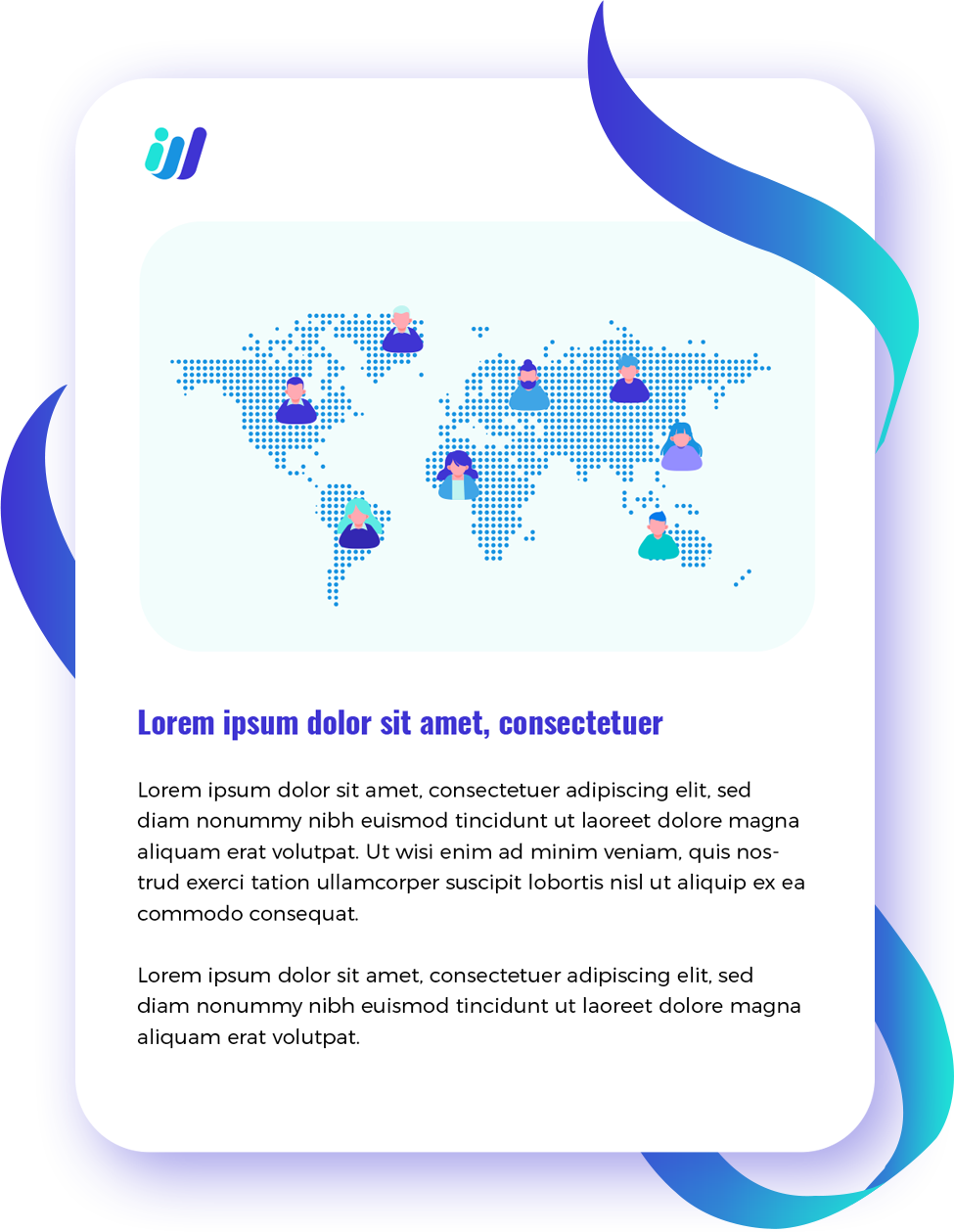
The world is a lot bigger than just one or two hubs now. Different regions bring different superpowers to the table:
- The Philippines: Still the GOAT for customer experience and cultural alignment.
- India: Shifting from cheap code to high-end R&D and engineering.
- Vietnam: The new powerhouse for tech-ready IT talent.
- Latin America: The nearshore favorite for US companies that need team members in the same time zone.
- Poland: Where you go when you need rock-solid, maintainable software development.
How to Actually Do This (Without Losing Your Mind)
Moving to a Third Wave model isn’t just about signing a contract. It’s a mindset shift.
- Stop calling them vendors. They are your partners. If they don’t understand your mission, they can’t help you innovate.
- Invest in the Stack. You need Slack, Zoom, Asana, and probably a few AI-orchestration tools to keep everyone on the same page.
- Address the Human Factor. Your in-house team might feel threatened by AI or outsourcing. Be transparent. Upskill them to manage these new global resources. The goal is to free them from busy work so they can do genius work.
The Bottom Line
The distinction between in-house and outsourced is evaporating. In 2026, the most successful companies won’t be the ones with the biggest offices; they’ll be the ones with the most effective global ecosystems.
The question isn’t whether you should outsource it. It’s whether you’re ready to lead a borderless team that never stops innovating.
Ready to dive deeper into how Third Wave Outsourcing can future proof your business strategy? Download our comprehensive Ebook to explore the nuances of finding the best talent, building powerful partnerships, and leveraging this global shift for sustained success. The future of outsourcing is here. Are you prepared to embrace it?