There’s a strange paradox in business today. We have access to unprecedented digital tools and seamless global connectivity, yet many companies are still anchoring their growth to the most inefficient hiring model available: a strict 30-mile radius around their headquarters.
For a long time, we did exactly that. But eventually, we had to face reality. Restricting our customer support recruitment to a local “talent desert” wasn’t just old-fashioned; it was becoming a structural liability.
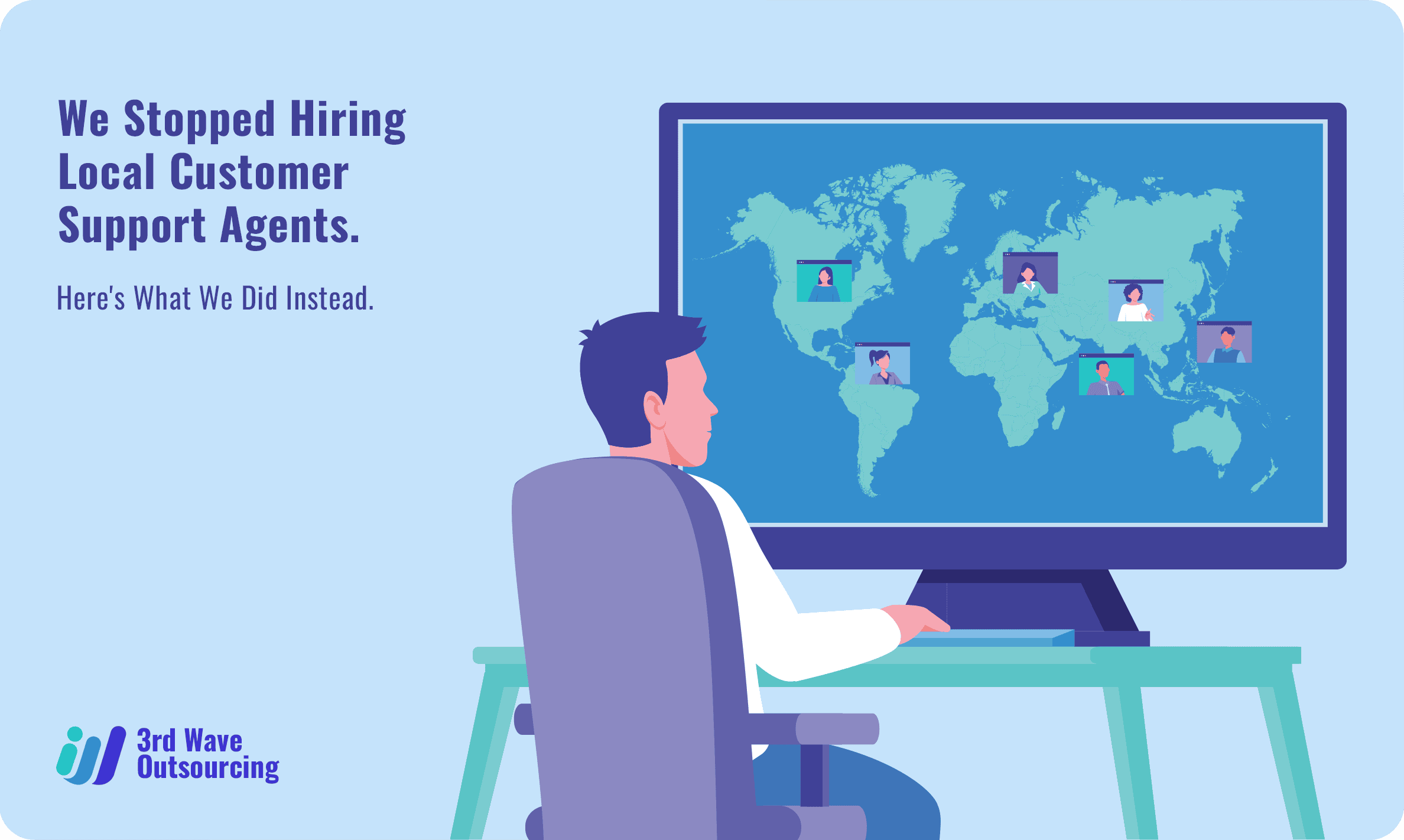
Here is exactly why we stopped hiring local customer support agents—and how we built a borderless, highly resilient talent extension instead.
The Financial and Operational Breaking Point
The traditional in-house customer support model carries compounding inefficiencies that eventually cap your growth. For us, it came down to two glaring issues: unsustainable overhead and debilitating attrition.
Let’s look at the real math of domestic hiring. Base salaries of $30,000 to $60,000 are just a mirage. When you factor in mandatory benefits, payroll taxes, office space, hardware, and management overhead, the fully loaded cost of an in-house agent in North America skyrockets to between $71,000 and $103,000 annually.
But the money was only half the problem. The real killer was the turnover.
In high-stress contact centers, median annual turnover rates frequently hover between 40% and 46%, sometimes spiking past 60%. Local agents are routinely pushed to the brink, handling back-to-back inquiries under uncompromising KPIs. Burnout isn’t a risk in that environment—it’s a mathematical certainty.
This creates a perpetual “ramp-down effect.” Consider the operational drain:
- The Learning Curve: New hires need 90 to 120 days to reach full competency.
- Metric Degradation: During this ramp-up, first-contact resolution (FCR) rates drop 10 to 18 points, and average handle times surge.
- The Bottom Line: For a standard 100-agent operation, this constant cycle of recruiting, training, and losing staff burns an estimated $2.25 million to $4.6 million every single year.
We couldn’t out-train a fundamentally broken system. We needed a new paradigm.
Escaping the Vendor Trap: Third Wave Outsourcing
To fix this, we didn’t just look for a cheaper vendor; we changed how we view global talent entirely.
If the First Wave of outsourcing was about cheap labor (often resulting in terrible customer experiences), and the Second Wave was about basic process efficiency, the Third Wave is about strategic partnership and digital transformation.
We stopped treating offshore personnel as disposable commodities. Instead, we focused on building an integrated, borderless team that leverages cloud-native applications and generative AI. We wanted top-tier global talent, not just bottom-tier cost reduction.
Why the Philippines Became Our Global Talent Epicenter
To execute this Third Wave strategy, we turned to the premier destination for high-value offshore support: the Philippines.
The Philippine IT-BPM sector isn’t just growing; it’s evolving. By 2026, it is projected to generate over $40 billion in export revenues, employing up to 2 million professionals. And this talent pool offers strategic advantages that go far beyond labor arbitrage:
- Exceptional Communication: A 99.27% national literacy rate combined with near-native English proficiency and neutral accents.
- Cultural Alignment: A deep, ingrained familiarity with Western consumer expectations.
- Career Longevity: In domestic markets, customer support is often a temporary, high-stress stepping stone. In the Philippines, it is a respected, long-term career path. This drastically reduces voluntary attrition and builds deep institutional knowledge.
Here is a look at the financial reality of this transition:
(Data compiled from recent 2025/2026 global outsourcing and labor market analyses.)
How We Built a Borderless Talent Extension
You can’t just hire offshore, hand over a script, and expect magic. Replacing local teams with a global workforce required a complete operational redesign.
Here is our playbook for making it work:
- No Second-Class Citizens: We built a blended workforce. Offshore project specialists work side-by-side (virtually) with in-house leadership.
- Deep Cultural Integration: We overhauled our onboarding. When global agents actually understand and align with a brand’s core values, they deliver empathetic, unscripted interactions that legacy BPO models simply can’t replicate.
- Technological Parity: Our offshore teams use the exact same advanced CRM platforms, analytics dashboards, and AI-augmented workflows that our internal teams use. This ensures frictionless data flow, strict cybersecurity, and total operational consistency.
- Organic 24/7 Coverage: By utilizing a globally distributed team, we naturally established round-the-clock service. We no longer have to force domestic workers into health-degrading overnight shifts, which protected employee mental health across the board.
The Takeaway
The decision to stop hiring locally wasn’t just about cutting costs. Relying on a restricted geographical radius was artificially limiting our scalability, inflating our overhead, and exposing us to crippling turnover.
By embracing Third Wave Outsourcing, we transformed our customer support from an inefficient, high-stress cost center into a highly resilient, globally scalable strategic asset. The talent is out there. You just have to be willing to cross borders to find it.
Ready to dive deeper into how Third Wave Outsourcing can future proof your business strategy? Download our comprehensive ebook to explore the nuances of finding the best talent, building powerful partnerships, and leveraging this global shift for sustained success. The future of outsourcing is here. Are you prepared to embrace it?